
Blocktec AAC Blocks Advantages
Upgrade your construction with Blocktec AAC Blocks.
Product Guide PricelistAutoclaved Aerated Concrete (AAC) blocks in the Philippines and Asia represent a modern, sustainable building solution with historic roots in early 20th-century Europe, now driven by rapid urban growth and green building initiatives. Their advantages of lightweight, energy efficiency, and durability position AAC blocks for continued strong market expansion in Asia’s construction sector.
AAC blocks originated in the early 20th century, with industrial production beginning in Europe in the late 1920s. The technology spread globally, reaching Asian countries like Japan in the early 90's. The Asia-Pacific region now leads the AAC market, driven by rapid urbanization, population growth, and government mandates promoting energy-efficient and green construction materials. Countries like China, India, and Southeast Asian nations, including the Philippines, see substantial demand for AAC blocks in residential, commercial, and infrastructure projects.
Why Upgrade to Blocktec AAC

Build Faster & Stronger
No plastering, no drying, less columns, ease & speed
in construction time

Cost-Efficient
Less wastage & more than 25% savings vs CHB

4-Hour Fire Rating
Up to 4 hours Fire Resistance Period (FRP) which
means more safety for your family and property

Lightweight, Less Dead Load
More savings on steel, cement and lesser dead
load of the building

Higher Noise Reduction
Reduces noise from external sources giving
you more peace and quietness

Cooler Space
Very low coefficient of thermal conductivity which creates a cooling effect and saves electricity for air conditioning

Excellent Water Resilient
Provides superior resistance to moisture
penetration than concrete hollow blocks

Environment-Friendly
Blocktec AAC blocks are non-toxic, reusable,
renewable and recyclable
Technical Specifications
Applications | Fire Wall, Interior Wall, Exterior Wall, Perimeter Wall |
Compressive Strength | 508~580psi Eco Series |
Length x Width | 600mm x 200mm |
Thickness | 100, 125, 150, 200, 250 |
Nominal Density | 450-550 kg/m3 |
Shrinkage | 0.02% |
Thermal Conductivity | 0.16 - 0.26 w/mK |
Fire Resistance Period | 4 Hours |
Sound Transmission Class | STC46 |
Expansion Coefficient | 8x10ˉ6K ˉ¹ |
Permeability of Water Evaporation | 0.223ng/Pa.s.m |
Moisture Absorption | 2.9% mass/vol |
Modulus Elasticity | 295,000N/mm²
|
Modulus of Rupture | 115(MOR) N/mm² |
Ingredients | Calcium Silicate, Crystalline Silica/ Quartz, Portland Cement, Lime, Anti-Corrosive/ Additives |
Disclaimer:
Please be aware that the technical specifications of our Autoclaved Aerated Concrete (AAC) products are subject to change. The precise specifications, including but not limited to density, compressive strength, and thermal conductivity, may vary based on the specific product model, type, and manufacturing batch. While we strive to provide accurate and current information, ongoing product development and quality improvements may lead to variations. We recommend confirming the exact specifications for your intended product with your sales representative or by referring to the product's official data sheet at the time of purchase. The final specifications are those of the product delivered.
Installation Methodology
The installation of autoclaved aerated concrete (AAC) blocks involves the following steps:
- Preparation of the foundation: The foundation must be level and stable, and the walls must be straight and plumb. The AAC blocks must be supported by a solid concrete footing or a reinforced masonry bond beam.
- Cutting and shaping: AAC blocks may need to be cut to size to fit the specific dimensions of the wall. This can be done with a carbide saw equipped with a diamond blade.
- Laying the blocks: The AAC blocks are laid on top of a bed of mortar and are spaced apart to allow for the application of mortar to the vertical joints. The blocks are then tapped gently into place to ensure a tight fit using rubber mallet.
- Application of AAC Adhesives: The vertical joints between the AAC blocks are filled with a special AAC adhesive that is designed for use with AAC blocks. The adhesive material must be applied consistently and must be smoothed to ensure a neat and uniform finish using trowel with different dimension that fits with the size of the AAC blocks.
- Seismic Gaps: Put 15mm - 20mm seismic gap between the AAC blocks and beams and columns.
- Horizontal and Vertical Rebars for Dowel: The 8-inch with 100m diameter rebars are drilled in the beam and columns and embedded into the blocks.
Accessories: Rubber mallet, carbide saw, dowel bar(8inches, 10mm diameter), AAC Adhesives, cement, leveling bar, drill mixer, trowel
Watch our videos for more specific details.
Ingredients
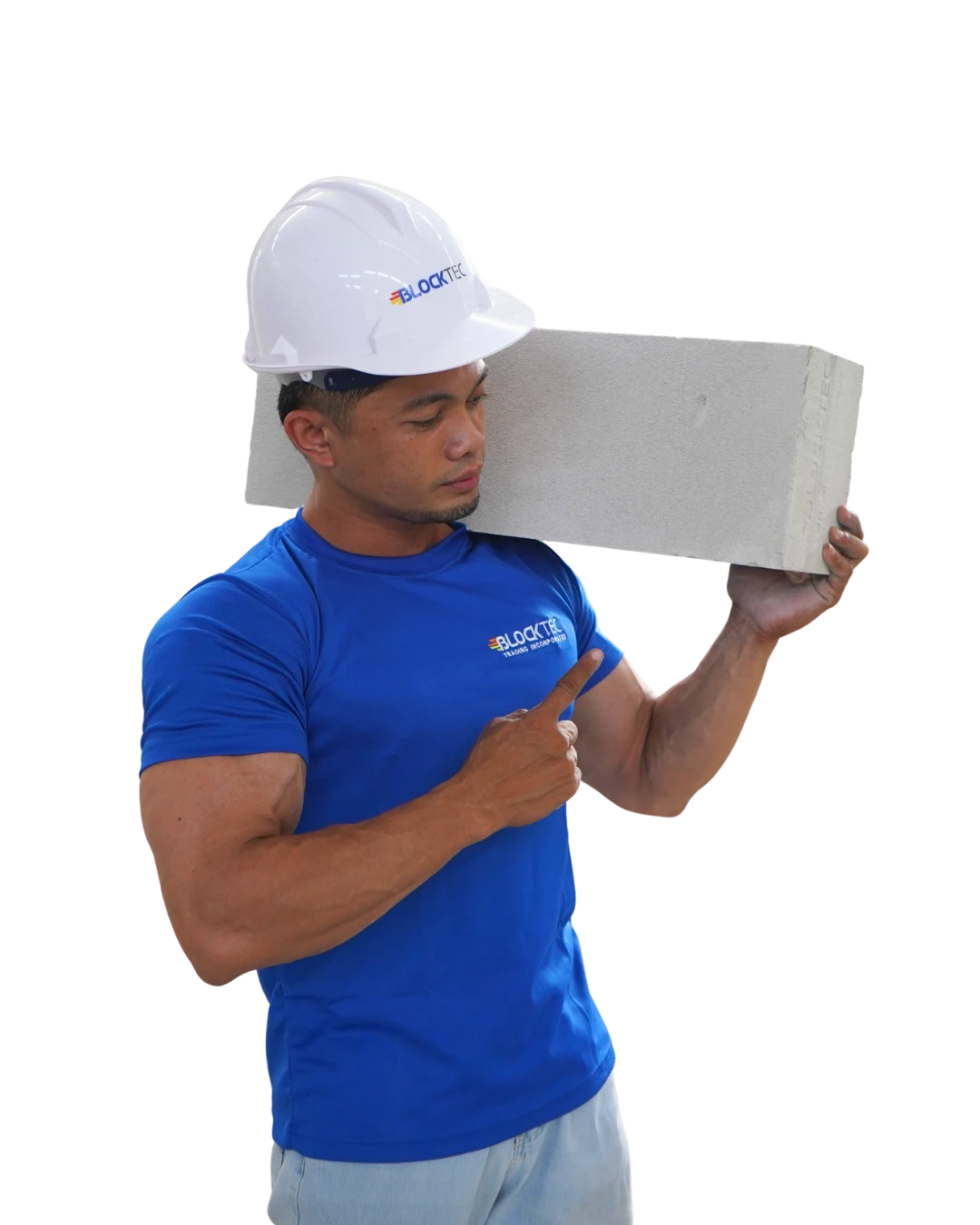
Tipid sa gastos at oras pero sagad sa lakas.
It's the perfect time to upgrade your construction to Blocktec AAC Wall System!
